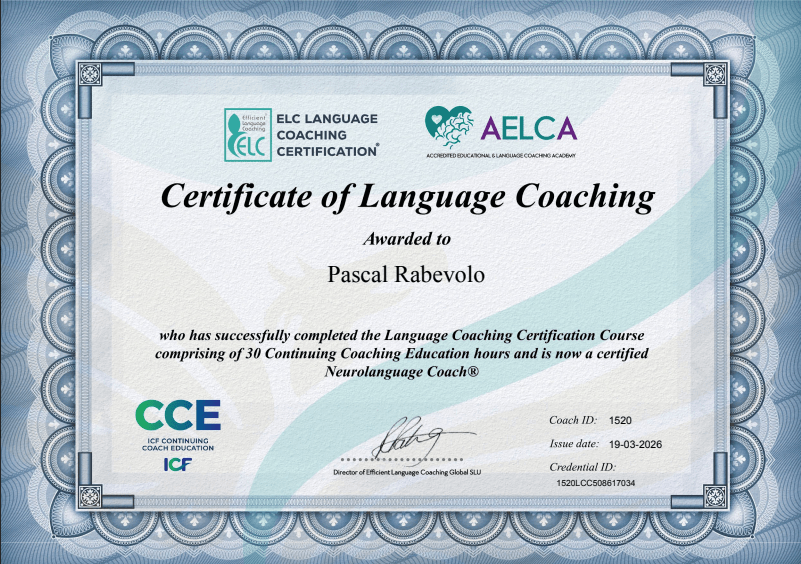
I have just earned a new certification as a language expert after successfully completing the ELC Language Coaching Certification (LCC) training program. This educational and instructional approach combines the principles, structure, and standards of professional coaching with the principles of neuroscience, emotional intelligence, and psychology, in order to adapt the learning process to how the brain works and tailor it to each learner.
After a year of immersion to adapt my teaching practices—validated by this certification—I can now offer my learners a fresh approach based on the latest advances in neuroscience applied to language teaching.
What exactly does this involve?
The neurolinguistic coaching approach is part of a comprehensive neuroscience-based coaching methodology that combines emotional intelligence, cognitive functioning, and brain-based learning. It aims to optimize interpersonal communication and facilitate language acquisition through practices drawn from modern language education.
This type of language coaching, often led by a language expert, is based on communicative language teaching and communicative approaches that place the learner at the center. Learner-centered learning thus promotes sustainable learning development by taking into account emotions, motivations, and cognitive profiles.
What does this actually involve?
The approach utilizes tools such as active listening, personalized learning strategies, and collaborative learning to strengthen autonomy and engagement. It also aligns with a life coaching framework, addressing confidence, barriers, and personal goals.
Finally, integrative approaches such as NeuroHeart Education enrich this framework by connecting cognition, emotions, and human relationships, leading to deeper, more effective learning that is aligned with the brain’s natural functioning.