
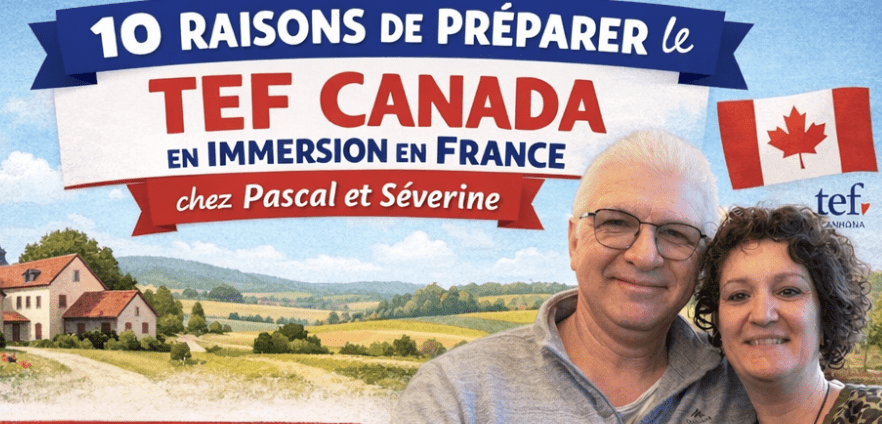
To give yourself the best possible chance of success on the TEF Canada exam, there’s nothing quite like an immersion program in France—with a personalized curriculum tailored to your needs, your areas for improvement, and your performance level on each section.
Why the TEF Canada Matters for Your Immigration Application
As part of the immigration process to Canada, English speakers—even though English is their native language—must still take an English proficiency test. In addition, there is a French test, since French is the country’s second official language. The higher your scores, the greater your chances of having your application approved.
Other factors certainly come into play—such as professional experience and educational qualifications—but language proficiency remains essential. Preparing thoroughly for the four TEF Canada sections significantly increases your chances of success.
If you already have a job offer, the stakes are lower, but language proficiency always facilitates much better social and professional integration.
The application process takes eight to nine months on average. All the more reason to give yourself time to learn the language properly before starting the process, and then to continue learning throughout the process.
Test centers hold regular sessions around the world for both the TEF and the TCF. Preparing for the tests in France right before taking the exam allows you to focus much more effectively on your goal, in a significantly more supportive environment.
The exam consists of four separate sections. You must achieve at least a B1 level, though B2 and C1 levels earn significantly more points. If you’re unsure of your current level, start by taking a free French proficiency test.
10 Reasons to Prepare for the TEF Canada Through Immersion in France
The quotes following each point come from students who prepared for the exam with us, most of whom advanced from B2 to C1 during their stay.
1. Total immersion in the French language
Living in France on a daily basis provides constant exposure to the language, both spoken and written. This naturally accelerates comprehension, spoken expression, and the memorization of essential structures for the TEF.
It’s a true immersion in the French language, as Pascal and Séverine make sure to limit interactions in English as much as possible.
2. Practicing with native speakers
Being surrounded by native French speakers facilitates spontaneous practice in everyday contexts: meals, leisure activities, and sightseeing. It’s a way to directly apply the skills assessed in the comprehension and expression sections of the TEF.
When you’re surrounded by French, you can’t help but learn. Plus, it’s real French—just as it’s spoken by native speakers.
3. Personalized instruction tailored to specific goals
Pascal and Séverine design a customized program that can be specifically geared toward exam preparation—including the TEF—by focusing on the skills assessed in the test: listening, reading, speaking, and syntax. This is the focus of the Intensive program.
After a three-week immersion program, my exam results exceeded my expectations. I significantly improved my scores in all four skills, which will help me achieve a higher ranking with the immigration office.
4. Active and Effective Teaching Methods
The neurolinguistic approach (NLA) and the verbo-tonal method of phonetic integration, incorporated into the classes, are designed to improve fluency, pronunciation, and intuitive comprehension—skills that are useful for all parts of the TEF exam.
Practicing oral simulations under real exam conditions every day with Séverine helped me internalize my phrases. On the day of the exam, it was very easy and comfortable to use them.
5. A calm environment conducive to learning
The program takes place in a small village in western France, far from urban distractions. This fosters intense focus on the language and exam strategies.
The location is ideal for focusing solely on learning. Unlike in big cities—especially Paris—here, people and shopkeepers let us practice our French without judging us.
6. Immediate feedback and personalized correction
During the immersion program, students receive direct and targeted feedback on their mistakes—grammar, pronunciation, and written and spoken expression. This is essential for maximizing your chances of success on all sections of the TEF.
Receiving immediate corrections throughout the stay allows for faster learning of correct sentence structures and appropriate expressions, without giving recurring mistakes time to take root.
7. Cultural competencies integrated into the learning process
Understanding French culture enhances your awareness of linguistic nuances—accents, registers, idiomatic expressions—that may appear on the exam.
Experiencing real-life situations helps students make the connection between the language and concrete aspects of daily life, as well as intonations and stress patterns that vary depending on the speaker. You learn something new every day.
8. Fully Immersive Experiences
Daily activities—local tours, meals, informal conversations—allow you to practice French in real-life contexts. This is what builds the fluency required for the oral sections of the TEF.
Every day offers an opportunity to expand your vocabulary on a variety of topics, chosen based on your own interests. You’ll then encounter these topics in exam questions or instructions.
9. Results Confirmed by Former Participants
Former participants report rapid progress and a welcoming learning environment, which helped them achieve high proficiency levels, including in exam settings. You can read their full testimonials.
The coaching I received was easy to follow, very comprehensive, and relaxed enough to avoid any unnecessary stress. Trust in the process and the duration of the immersion leave nothing to chance: success becomes a given, the result of continuous and systematic work.
10. Combining Immersion and Intensive Exam Prep
A stay with Pascal and Séverine can be structured to include targeted exam preparation—mock exams and strategies specific to the TEF—while still enjoying true language immersion.
The cultural outings allowed me to explore the region while practicing my French in a relaxed setting with locals, and to better understand how to use the language in real-life situations. This is also one of the exam’s requirements.
What the TEF Canada Actually Assesses
The TEF Canada measures concrete French language skills—listening, reading, speaking, and writing—in the context of Canadian immigration. Preparation that combines constant immersion with structured instruction significantly improves your ability to perform well across all these areas, far beyond what isolated theoretical preparation alone can achieve.
For the official test framework, visit the Test d’évaluation de français page on the Le français des affaires website. For the equivalent exam offered by France Éducation internationale, see the TCF Canada overview.
Prepare for Your TEF Canada with Us
If you’re preparing for the TEF or TCF Canada as part of an immigration plan, let’s discuss your timeline and current level. The program is tailored based on your results on each of the four sections.